


Its really nice to see that this blog is mentioned in the PM Network magazine August 2006 Issue through “Social Network” article.
You can find the soft copy at http://www.pmi.org/info/PIR_PMNetworkOnline.asp
Very big thank goes to the person who wrote that/recommended this blog.
Thursday, August 10, 2006
Easy Scrum – 2
First I thought of writing details of each step of Scrum. with that idea in my mind, I posted “Easy Scrum – 1”. But Yesterday I did sort of a case study with one of my teams to practice Scrum. So I thought its worth to write about it and it covers the whole cycle.
Ok here it goes…
I got the team together, none of them have practiced Scrum before., I did some initial presentation of Scrum to get some idea and then gave them the case study.
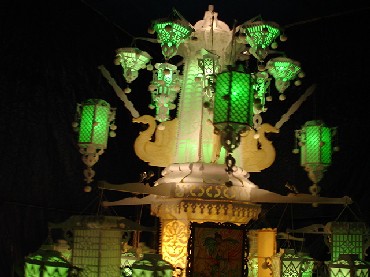
The case study was a Project to make a “Vesak Lantern”. ( I have very few Sri Lankan readers reading my blog, but so many overseas readers. So its worth to explain what a Vesak Lantern is . Vesak Lantern is a Lantern we Buddhists make for the Vesak day ( Lord Buddha’s Birthday )celebration ). So all my team members have made at least one vesak lantern and they have the “Industry Knowledge” . So it was easy. I acted as the customer to change the decoration requirements of the Vesak Lantern the way I want ( It was annoying J )
Project Constraints:
Product Backlog :
We have to light the lantern on the Vesak day night.
So the team got busy. First I selected a Scrum Master. And I asked them to create the product backlog.. That was interesting., Planning, Designing, Making the Skeleton, Purchasing Materials, pasting papers, Setting Light Bulbs so many things in the list., .. What happens if there is a power failure on Vesak Day.? ( Which is very common in
The design we wanted was a aero plane shape of a Lantern. But I kept on asking changes to that.
Once the Product backlog is made, it was estimated with required man power cost and the material cost. But the team had to revise it many times and recalculate it as the requirements kept on elaborating
Then the priorities were decided by the scrum master and the team., of course you cannot paste papers without making the skeleton. They prioritized the tasks accordingly
Sprint
They defined sprints, durations for Sprints were vary. They selected the Items based on the resource availability and Priority for the first sprint. Sprint backlog was created.
Daily MeetingsHow about the people who try to skip meetings? Do we have a penalty.. Yeah .. Rs. 100 ($1 ) should be collected from absentees and use it for team outings after some time…If I have a good team.. I will not have money in the till :-)
This is a very productive thing.. We do not slip daily targets and we do not postpone work until the last day and then struggle with it or just do something about it.. I know the team will find this bit hard at first. But they all will appreciate it after some time..
Burn down Charts
Scrum master created the Product Burn Down chart based on the items taken off for the sprint. We didn’t create any Sprint burn down charts as our duration for the sprint is very short.
One of the objectives of daily standup meetings is that to foresee the barriers for the team to achieve their daily workload and eliminate those barriers. So we are not waiting till the last minute project meetings in order to find why we have not achieved such tasks and to realize its too late.. They found that the guy who had to purchase material doesn’t have a vehicle to go to the stores. So they have eliminated the problem by hiring a vehicle for that.
Product backlog Delta Report
Scrum master kept on updating the product backlog Delta report. I found the status of items as follows.
In Progress
Done
Deferred
Deleted
We completed the lessons learned after every Sprint. So we could more or less eliminate the over estimating issues in latter sprints.
Project Management office?
Every team member feel that they have a major Stake in the Project.
Team members have a very good understanding of the workload and the challenges they should face in the project as a team.
Team members don’t feel that work is assigned to them., they feel that they have volunteered to do tasks as they want to be the winning team.
Over all very good Project Control
With this method.. you are never too late.. Because you don’t wait till you are too late.
Its no more covering backside for anybody..
Difficulties I see
Taking leave affect the sprint backlog
Difficulties of committing to the final deadline due to multiple iterations
Difficulties to negotiate with project budgets time to time
Thursday, August 03, 2006
Easy Scrum - 1
But we have many challenges..
We don’t have a Scrum Master. We have only a Project Manager. We don’t have a Customer working with us., But we have a Domain Expert within the team who will act as our customer. We don’t have Microsoft Team Systems. But we have Microsoft XL. We have a Project Office which needs some sort of generalized templates of all the projects.
How do we go with it.. ?
First I wanted the team to be familiarize with Scrum. The Problem is training.. We don’t have such training and workshops available here and no project budget to send them overseas. So the next option was Web and Online mentors.( Which is the only option we had)
Step 1 - Create Product Backlog
First we got to create a Product Backlog.. How do we do that? Its very Simple.
You got to create a list of all the product functionalities ( You can simply use a XL sheet or MS VS Team Systems). You may have got so many documentation at this time. Go through it clearly, understand the required functionalities, understand everything what you have to do with the project, List them. Then prioritize them in order to see which ones to be completed first, depending on their dependencies, impotencies and effort requirements.
Then the question comes.. Who can add items to Product Backlog.?? Do I have to secure this sheet with a Password? No ..In our case we asked everybody to add items., PM, Tech Lead,Project Owner, Team, Domain Experts and so on. Then we prioritized them based on the required functionality of the product in order to do release 1 of the product.
Remember your good old WBS? (Work Breakdown Structure is the deliverable based grouping mechanism inProject Management ).. You can see the Product Backlog as something similar to that. Both can be used by the PMO to understand the amount of work to be carried out in the organization’s projects. The Difference is that WBS is a Deliverable based Grouping and it doesn’t reflect prioritization of your task or estimations. Its more or less defined, and its created by the Project Manager. But Product backlog has almost everything you got to do with the project. It shows which tasks to be done first., and the value and importance of them. Any stakeholder can add items to the backlog. New Items will be added over a time period.
WBS helps a PM to plan the required work Packages and estimate them., Product Backlog helps the PM and team to plan items for a Sprint. ( Short time Period) and estimate the work to be carried out.
- A new Item is added to the Product Backlog
- Existing backlog item is substantively changed.
How do you estimate the Product Back log? Are you going to categorize items by Size and put a weight on each category? Or is it by any other costing methodology?
Tuesday, July 25, 2006
Which Type of a PMO?
- project office
- basic PMO
- standard PMO
- advanced PMO
- centre of excellence
you can see what type of service your PMO does, or willing to do /Suppose to do. Based on that, the PMO budgets, the seniority levels of resources, responsibilities, authorities and everything changes.
The difference between a Project Office and Project Management office is that, the Project office delivers Projects within approved budgets and required quality. But Project Management office always look for consistency, and improvements of methodologies, Frameworks you practice, consistent templates, etc.
A Standard PMO establishes capability and support infrastructure while advanced PMO applies the PM capabilities to achieve business objectives. So you need a very senior level manager in your organization as the head of PMO in such level.
There is a Top category called
As I mentioned in one of my previous PMO related posts, you may not be able to setup a center for excellence at once in your organization. You may start with Project office and then improve on that based on the opportunities you have.
Recently I had a chat with a CEO of a SL IT company who had the idea that setting up a PMO is just wasting company resources. But when I asked him why he has very high PM turnover, I found out one reason., PMs do everything for everybody, But there is nobody who can listen to PMs , mentor them., get them on one specific goal., keep them focused. so I told him that he needs some sort of Central management of his Projects.
PMO is not such a magical thing., By knowing or not knowing, we have been practicing PMO concepts in our organizations. I can think back to see what I have been doing 2, 3 years before when I was a Software Development Manager. Though the designation is different, I was responsible for all the projects running in that organization. I had PMs reporting to
Then the next question he asked me was that, they use Agile methods such as extreme Project Management and it might clash with PMO setup? My answer is NO., Because your PMs can use agile methods (infact I have fallen in love with them :))., But you should maintain some consistent between your project management tasks., If I take an example from an offshore software company like ours., there are different types of Projects, some customers insist on Prince2, Some project managers need to practice Agile methods due to the nature of projects ( if they have direct interactions with customers - very rarely though)., some are well defined just for the PMBOK way of management. This is very complicated and its challenging. But no matter which methodology we practice, we need a core, to understand the project issues, management issues, mentor PMs , assign them for right project so on. You can generalize your PMO templates to match all the types of PM methodologies you practice., Though you have daily standup meetings or you have once a week formal project reviews, you need status reports. You need to document important decisions. So try to generalize the templates as much as possible but its always understood that some PMs carry different stuff as user stories reports and so on based on the methodologies they practice.
Monday, July 24, 2006
Have I said too much....?
Oops I think I have miscommunicated something.. Mea Culpa!!! I just listened to the PMpodcast latest show and it talks about some communication I had with the host of the podcast show regarding the blog bann.. I think I have miscommunicated something to the host of the show and Im extremely sorry about that.
I just tried to see where I can put a comment /an explanation on the podcast show., But I couldn’t find any place to post comments.. So Here it goes in my blog…
http://www.siliconvalley.com/mld/siliconvalley/15082363.htm
There is no threat as yet in Sri Lanka( besides there are many rumors on that),But it might happen soon in SL as well., lately they have thought of restricting all most all the media activities such as Hollywood movies, Foreign programs, Advertising Imported Milk powder, watching TV after 10PM .. List goes on…..
So I wish that will not happen in SL .
"
It's hard to understand how the current Indian government ban on Blogspot, Typepad, Geocities, and other major web domains can possibly be justified as an anti-terrorism strategy. Apparently some people involved with banned groups like SIMI have been using blogs to communicate, and the government has instructed the nation's ISPs to ban those sites, which host thousands of Indian blogs"
Guys have a look at it … www.thepmpodcast.com
Tuesday, July 18, 2006
Number worth a thousand words...
Today, I found a very interesting Project Management blog., ( Thanks to Cornelius’s Helpful Resources listed at www.thepmpodcast.com )I think its worth to write few lines about it.
This is all about working with Numbers in Project Management. We always talk about Technical PM skills, Soft skills required by PMs, Different Methodologies, EVM calculations.. so on.. But this author talks about Project Management and according to him its all about numbers… Its interesting and I hope you will not regret for visiting his blog
Project by Numbers - by Bas de Baar
Monday, July 17, 2006
PMI INTRODUCES PROGRAM MANAGER CREDENTIAL
There is another certification introduced by PMI. That’s for Program Management
( Multiple Project Management)
What that says is the program manager should have advanced skills in finance, cross-cultural awareness, leadership, communication, influence, negotiation, and conflict resolution.
Any way these are essential skills for any Project Manager. Having responsibility of multiple project means more planning and aligning project goals with business goals. BTW its something interesting to look forward to…..
( Multiple Project Management)
What that says is the program manager should have advanced skills in finance, cross-cultural awareness, leadership, communication, influence, negotiation, and conflict resolution.
Any way these are essential skills for any Project Manager. Having responsibility of multiple project means more planning and aligning project goals with business goals. BTW its something interesting to look forward to…..
Wednesday, July 12, 2006
I wish if I could see them....
This is nothing related to Project Management again.. But something which interest me so much….may be more than Project Management….
There has been a UFO sight in
Too bad I missed the whole thing., :( What a Looser I am :(
but my friends who watched news said that it cant be a lie as those villagers are not so crazy people like us who always dream about ETs. Some people have seen 2 feet long gold color unusual 2 persons and they have said that they were just like small children..... Can you believe that ???
Im searching more information on this ..
Today I told about this UFO news to my colleague Gogula who believes that god is an alien being….. He was so enthusiastic about the UFO arrival and wanted to throw a welcome party for them …. This is what he told me through skype…:)
“We have to start a campaign to welcome our space brothers
And we need a lot of people for this...
We need costumes first
We need fluorescent lights handheld ones
We should also make a sort of a dance and chant so that are space brothers know that we're a re friendly
and that we're welcoming them...
But everything needs careful planning (hmm.. At last I have a part too.. :-))
We should also make a sort of a dance and chant so that are space brothers know that we're a re friendly :D
Otherwise they'll think we're hostile and may attack us
We should have some recruits who will be willing to face experiments
We could have a new breed of alien-humans
We could have the best of both
We could conquer new and unexplored frontiers
And we could be free. Our space-brothers will teach us about peace and harmony
We do not need race, country and all that….
There are people who will agree
Who will unite
We shall be bearers of peace and love...
This guy is a half crazy Alien… :)
--- Another ET Sight in Sri Lanka on 30th July 2006--------
One of the residents, Nissanka Ranadeva had covered a few spots in the sand in front of his house with aluminium pots and pans. By torchlight, he lifted these utensils to reveal odd-looking footprints in the sand. The footprint showed clearly that whatever these creatures were, they had three toes and heels. There were over eight or nine such prints on the sandy garden. We got the impression that constant viewing and the passing of three days since the initial sighting had wiped away most of the prints.
The first to see the three strange creatures were an elderly lady and her grandchildren. They stay close to the Sarvodaya centre. “It was about five or six in the evening of the 23rd. There is a three way junction near our house, surrounded by shrub jungle. My grandson, Ujitha Tharanga and my granddaughter Udeshika Madhushani and I were walking towards our house. Ujitha suddenly shouted ‘Look, Achchi, three people are looking at us.’ I couldn’t see much. My eyesight is quite weak. And we were quite far away,” R.M. Seelawathi explains her encounter.
Madhushani saw things a little more clearly. She is a 12th year student at the Thanamalwila National College. “We saw three mysterious people. I have never seen people like that. All three were very short. The one in the middle was slightly taller than the others. They stared at us for a while and then they ran into the forest,” she said.
Her brother Ujitha claims they disappeared altogether suddenly. He described the three little men. The description was fairly stereotypical, although in a single aspect, the image did not fit with your common or garden E.T. The villagers saw big, glowing eyes and large heads on the dwarf men, but he also described them as black skinned.
At 6 a.m. the next day, three young women in the area, Merani, Sagarika and Rasika saw the same three creatures on the banks of a small stream, a tributary of the Kirindi Oya that flows through the little forest reserve. The stream borders the Thanamalwila town on one side and the Sarvodaya camp on the other. The three village girls headed down to the stream for a bath and were midway through it when they spotted three small men staring at them from about 100 metres away on the river bank. As before, the creatures had run away the moment they realised they had been spotted. The three girls were not available for comment. But we made our way towards the spot where they claimed to have seen the ‘aliens.’ Like in Nissanka’s garden, there were footprints along the river bank, identical to those we had previously seen.
Monday, July 03, 2006
Scrum - Agile Project Management

Have you ever tried Agile method of Managing Projects? What do you think of that? In my environment we have very rare opertunities in such methods. We won’t get customers who work with us so closely for projects. But I think its a very practical aproach. If you are lucky enough to have a chance to try out... do so., ( But it can be very messy if you dont do it right..or if you dont have right people.... Handle it with care....
Lately I did a little study on Scrum method of managing projects., hmmm.. Personally I feel it put some additional weight on Project Management due to daily progress monitoring with team meetings and deliverable management due to multiple releases. But it sounds very practical.
“Scrum is an agile method for project management. It has been documented to dramatically improve productivity[citation needed] in teams previously paralyzed by heavier methodologies. Scrum was first documented by Takeuchi and Nonaka in "The New New Product Development Game"”
Scrum is defined for Software Development projects., But I it can be mapped for any other projects such as Maintenance management etc.
Some important aspects of Scrum are as follows,
• Customer must become a part of the development team. (i.e. He is genuinely interested in the output).
• Frequent intermediate deliveries with a working functionality is a MUST.
• Frequent mitigation and risk plans have to be developed by the DEVELOPMENT TEAM.
• Daily status discussion with the team is a MUST.
• Things to include in the daily discussion are:
o What did you do from yesterday?
o What are you planning to do tomorrow?
o Do you have any problems?
• Transparency is a MUST in planning and different modules.
• If a feature has a problem, no delivery shall take place.
• A frequent stakeholder meeting, to see the progress, is a MUST.
• No problems are buried under the carpet. No one is penalized for a problem.
• Energized workplace and working hours is a MUST. "More number of hours" does not mean more "output."
Listen to the interview
http://www.controllingchaos.com/?p=31 (A certified Scrum Master and PMP Certified Project Manager, discussing Scrum, an Agile project methodology primarily used for software application development projects.)
Other Reference
http://www.think-box.co.uk/blog/2006/05/daily-stand-up-scrum-meeting.html
http://jeffsutherland.com/scrum/
http://www.amazon.com/gp/product/073561993X/103-2254939-6536653?n=283155
http://radio.javaranch.com/lasse/2006/05/07/1147034972559.html
Sunday, June 25, 2006
Filling time sheets -How important
Its very important to fill work package level time sheets by every team member in the project team. The advantage of filling the times sheets are
1. As the Project Manager, You can track exactly the time taken for each work package, Actual vs. Estimated. That gives a good review about your time estimations
2. Time sheets help to understand the work performance of each individual in your team., These are good baseline documents for a project Managers to review his team
3. These records provide you information to be more accurate on your next project estimates and the contingency planning
Why most projects are completed without time sheets?
1. Projects doesn’t have an exact allocated budget or schedule
2. Project doesn’t have a Project manager to plan allocate and control tasks
3. No team members buy-in for filling time sheets. Normally the team members feel that they are going to be trapped with the time sheets and its only a controlling mechanism to find the number of productive hours.
4. Team members are allocated to many ad-hoc tasks, they answer support calls, help some other projects, etc. In this case they feel that the time tracking is just burden to them.
5. No proper system to view project tasks allocated to them and key in actual time against the estimates. ( If you don’t have proper software application, Don’t worry, recently I understood that you can set this simply using Microsoft portal server., You dine the Work package of your team., Allocate members., assign the time. Ask the team members to log in and key in timesheets.. Very simple. If its still complicated for you, Why don’t you use a simple excel sheet..)
Monday, June 19, 2006
Outsourcing .. Offshoring.,.. Multisourcing ....Is it that bad..???

I have been working in my whole career in the Outsourced/Offshore IT Project environment. My Project management research topic is also something related to this. While surfing the web, I came up with the following blog accidentally,
Do something what you are talented at....
Sunday, June 11, 2006
Payback of PMO - 1
2. Understand the cost of setting up a Project Office
Estimate the cost of setting up the Project Office. What are the common types of costs?
- You may need a consultant who has experience in setting up a project office., Or you can do by yourself with some support from your senior management
- If you don’t have good experienced Project Managers, You may need to recruit them. Or you may have to train your existing PMs and mentoring them., There is a cost for that too.
- You may need to Purchase some PMIS software, Or you can create your own one.,
- You may need to purchase some good PM templates or you can simply create them
(Start Small , Then you can keep your budget low.)
Friday, June 09, 2006
Collecting PDUs???
I renewed my PMP membership last week. One year has passed and Im left with no PDUs..Too bad…. How do I claim PDUs with All the project related work I do ?
How does other PMPs in SL collect PDUs? Have they given up on that?
Btw, what is PDU ?
”Professional Development Unit (PDU)
According to PMI’s rules, a person holding a PMP® certificate must work actively to develop his or her competence in project management. This is a must in order to keep one’s PMP® certificate. Every PMP® certified project manager must renew the certification every three years, and this requires PDU points. One is required to collect at least 60 PDUs during a three-year period.”. <..semcon.se>
How do we collect PDUs ? We don’t have such opportunities and PM events in
There are some Free stuff which you can get enrolled to earn PDUs online.
http://www.iil.com/webinars/ (Thanks to my friend who sent me this..)
Some other info I found:
PMP Continuing Certification Requirements (CCR): PDUs Made Simple
By: David M. Sides, PMP – January, 2006
Professional Development Units (PDUs) are divided into two basic groups:
• You get Project Management – Take courses, training, learning experiences for yourself.
• You give Project Management – Perform PM, publish, teach or coach others.
To maintain PMP certification, PMPs must accrue a minimum of 60 PDUs for each 3-year cycle. The cycle extends from the PMP exam date through December 31st of the third calendar year. Typically one hour of qualifying activity equals 1 PDU. PDUs can be earned in any combination, subject to restrictions shown below. Up to 20 excess PDUs earned during the final year of the current cycle may be applied to the next cycle.
Note: If you do not meet these requirements you will lose your PMP certification. To regain PMP status you must apply, pay, and retake the PMP exam.
The reporting process includes completion of an online CCR form, review by PMI, and subsequent renewal payment of $60 for PMI members ($150 for non-members). Since you must keep appropriate
documentation in case of audit, PMI recommends that you maintain PDUs online as they are earned. [I find it easier to keep an offline file and enter once at the end of my cycle.] Examples of required backup documentation include grade transcripts, certificates of completion, program agendas, published materials, program agendas, or class rosters.
Within these groups there are categories, each with specific requirements and possible limitations.
Category 1 – Formal Academic Education
PM-related course from a college or university for degree credit. 1 degree credit = 1 PDU. For
example, a 15-credit semester course = 15 PDUs.
Category 2 – Professional Activities and Self-Directed Learning
There are nine sub-categories, each with different PDUs, requirements, and restrictions.
2a – Author of PM article in refereed journal (30); co-author (20).
2b – Author of PM article in non-refereed journal (15); co-author (10).
2c – PM Speaker at conference, symposium, formal course (10).
2d – PM Speaker at PMI chapter meeting (5).
2e – Member of PM panel at conference, symposium, formal course (5).
2f – Author of PM textbook (40); co-author (20).
2g – Developer of content for structured PM learning program (10).
2h – Practitioner of PM at least 1,500 hours per year (max 5 per year, 15 per cycle).
2SDL – Individual PM-related learning, research, study, or coaching. 1 hour = 1 PDU (max 15 per cycle).
Category 3 – PMI Registered Education Providers (R.E.P.)
PM-related course from a PMI R.E.P. 1 hour = 1 PDU.
Category 4 – Other Provider
PM-related course from any other provider. 1 hour = 1 PDU.
Category 5 – Volunteer Service to Professional or Community Organizations
You may earn a maximum 20 PDUs per cycle in Category 5.
• Serve as officer in PM organization.
o Minimum 3 months = 2 PDUs per year.
o 6 months service = 5 PDUs per year.
o 12 months service = 10 PDUs per year.
• Serve as committee member in PM organization.
o Minimum 3 months = 1 PDU per year.
o 6 months service = 3 PDUs per year.
o 12 months service = 5 PDUs per year.
• Provide PM-related services to community or charitable group (5 PDUs per year).
For more details, see the CCR Handbook on pmi.org. Contact: david.sides@sogeti.com
Tuesday, June 06, 2006
PMO Objectives -2
Ok, you have already listed the objectives of your project office, the responsibilities, and now you have a Sponsor and a budget. you have the go ahead and the management buy – in.
The next big question. …. Do you have sufficient PMs in your project office to deliver the expectations? How do you find out? You can try the following,
Assess your existing Project Mangers (Their Knowledge, Experience, Training, and Past success records),
In this case, I would setup an interview with each PM., not more than 15 minutes per interview. Just an informal discussion. Before that I will be ready and list down all my expectations of PMs in the New Project Office.
At the time of the interview, I will give some marks for each expectation listed in my list. So end of it I know where I stand with my exiting Staff. This really helps to identify the individual’s different skill levels and areas needed to be improved. They may need some training, or some formal certification. You can make lots of decisions by using this simple matrix.
If you think that you need to recruit some new PMs for your project office, you have 2 options, either you promote somebody among your team members who is willing to be a PM or you recruit a PM from another organization.
Don’t ever do the mistake of promoting your best techie to a PM, unless he/she has PM skills. This is a common mistake done by most of the senior managers., either we force best techies to manage projects or they take that responsibility due to some other reasons. Unfortunately the result is that not only the project suffers, you loose your valuable technical resource too. My personal belief is that , Project Management is a born skill. You cant get a developer, teach him some methodologies and expect him to be a good Project Manager overnight.. Unfortunately it never works that way…A PM needs lot of experience to be a good PM., the decisions that he or she makes should be situational and practical. In this case, find capable people from your staff, Interview them and make sure their career path as a PM., Create some test cases for them with some complicated project issues., see their reactions to it., In this way, you can judge whether they will fit in to your Project Office.
In SL , recruiting an experienced PM from outside the organization is simply impossible., I do have lot of bad experience with that. One simple reason is that Project Management is still a very young profession in SL and no many experienced good PMs available in the job market., the few experienced PMs are already working in some reputed organizations and they are not willing to join another company easily. The other problem is that their financial expectations are too high., (With this job market, its impossible to practice Projectized Organization structure. You cannot release your PMs once the Project is over simply because you will never find any to start a new project again. In SL still there is no contract basis IT resource market. People are still thinking of stable jobs.. which we should discuss in some other post)
Lets think that somehow you got set of good candidate for your Project office., How do you select a good PM out of them., Recently I read one article ( Sorry I forget the name or reference) which says simulation is one of the best methods of interviewing a project manager. As an example, you setup the interview panel as a team, they act like stake holders with different attitudes. You provide your case to the PM candidate and ask him or her to conduct a meeting. You can observe how he or she handles the situation and overcome problems. But the problem I see in this is that you need to spend quite a lot of time for interviews, (though you try this only for short listed candidates). My simple method is again a Matrix. I prepare it with various expectations. Communication, presentation, conflict handling… the list is very long.. then I make sure that I ask at least one question to cover each area., I give marks based on their answers.. That works for me..
Monday, June 05, 2006
I feel I am truly blessed .. Thanks to some wonderful people around the world.!
I think I must write this note.. this is for all the good people who help others to come up in their career….
When I really thought of doing a research in PM ,I thought its an impossible thing to do. Who is going to help me? There are no many people in Sri Lanka who does research in Project Management.. That's why I posted my idea initially, with the heading "Something Stupid"…
But Its not something stupid any more…some wonderful people.. (I have never seen some of them)., made me think positive.. I'm so grateful to them. Dr.Bandu Ranasinghe spent time to listen to me and discuss about my Ideas and to guide me to do the right thing by forgetting his very busy schedule. Dr. Hewagamage - Colombo University agreed to help my research with no hesitation. (That really changed "my thinking" towards Sri Lankan Academic people) Cornelius Fichtner - My never seen PM friend from Switzerland (Currently in USA and he conducts the PMPODCAST SHOW) always encouraged me. Bill Bates- Principal of P3M Governance Inc.(and a member of PMI's Research Advisory Group- 2005) is going to the extend of helping me by putting me in touch with a number of project management researchers at the masters and PhD levels in USA. He himself gave me some ideas of PM research. There are so many other great guys around me including my best friend and colleagues. You guys are really great!
When I really thought of doing a research in PM ,I thought its an impossible thing to do. Who is going to help me? There are no many people in Sri Lanka who does research in Project Management.. That's why I posted my idea initially, with the heading "Something Stupid"…
But Its not something stupid any more…some wonderful people.. (I have never seen some of them)., made me think positive.. I'm so grateful to them. Dr.Bandu Ranasinghe spent time to listen to me and discuss about my Ideas and to guide me to do the right thing by forgetting his very busy schedule. Dr. Hewagamage - Colombo University agreed to help my research with no hesitation. (That really changed "my thinking" towards Sri Lankan Academic people) Cornelius Fichtner - My never seen PM friend from Switzerland (Currently in USA and he conducts the PMPODCAST SHOW) always encouraged me. Bill Bates- Principal of P3M Governance Inc.(and a member of PMI's Research Advisory Group- 2005) is going to the extend of helping me by putting me in touch with a number of project management researchers at the masters and PhD levels in USA. He himself gave me some ideas of PM research. There are so many other great guys around me including my best friend and colleagues. You guys are really great!
Friday, June 02, 2006
MPhil/PHD in Project Management
Today I met Dr.Hewagamage at
We discussed it further and the areas which I can get in to., He explained me how I should get in to the research and the process. Its hell of a work load and needs lot of commitment as I will do it while working.. But this is what I want to do. So Im sure I will have that commitment.
After the discussion I collected the registration form and came back to office., I got to prepare my research proposal. Before that I should be very clear with the area that Im going to do research on.. After the discussion that Dr. agreed to be my mentor. I’m honored..!
.............There's a battle ahead, many battles are won!!!
Subscribe to:
Posts (Atom)


