Sunday, April 16, 2006

Project Reporting – 2

3 comments

There are so many great templates in many project management sites. You can download them and customize them according to your requirements.

This is how I prepare it.

Page – 1 – Summary Information

Project ID : A1 ( How your Project office uniquely identify your project )

Project Name : ABC Business System ( Name of the Project )

Report Date (Current date )

Project Start Date:

Estimated End Date: ( According to your Project Schedule)

Current Phase: Execution (Whether your project is in Initiation, Planning, Execution, closing...)

Project Sponsor Mr. B

Project Owner ; Mr. A

Project Manager: Thushara

Section for Project Health – This includes areas such as status of the Project Scope, schedule and cost variances. Following is an Example;

Scope : Stable and Now frozen

Schedule Variance :(Please refer to EVM Post to see how to calculate this)

Cost Variance: (Please refer to EVM Post to see how to calculate this)

Schedule : project is 40 % completed

Project summary section; some important points about the project in point form. Summary of key milestones are listed here, Ex: Project Delivery date, Estimated UAT date Etc.

Then I introduce the color codes which I use in the project report. There after, they are called Project Health Indicators. Every task or issue is marked in one of these colors.

Project Health Indicators
Red

Not Progressing

Progressing with Significant Issues – Impact to Target Date, Budget and/or Scope

Amber

Progressing with Issues – Potential Impact to Target Date, Budget and/or Scope

Green

Progress with Insignificant or No Issues – No Impact to Target Date, Budget and/or Scope

Page – 2 – Project Activity Summary

Activity

ETC

AC

Current Issues

Data Sync Process

2nd Jan

2nd Jan

Task closed with no issues

System Integration with PDA

4th Jan

Ongoing

The team has not received the device for testing. The device is expected on ***

Authentication Module

4th Jan

6th Jan

The work completed and waiting for the QC reports


Look at this example. I list all the major activities here ( This should refer with the detailed project schedule) activities with major issues are highlighted in Red color., so anybody would notice them easily at a glance.

Page – 3 –Issues Summary

Issue No

Description

Responsibility

Progress

1

Provide PDA X5 model to the team

Shehan

The PO has been sent ., waiting for the delivery

2

Budget Revision

Project Sponsor

The 2nd phase of funding is required ., the meeting is arranged with the accounts Dept . on 15th Jan

4

The Team Member A has given resignation., Immediate Replacement needed

HR

Already allocated a new Member. Issue closed


I list all the issues I face with the project., Issues which are critical to solve and the impact is high, I mark them in Red Color, when the issue is closed I change them to Green color., This way I can get the attention from responsible parties to solve all the issues easily.

Page – 4 –Unresolved Risk Summary

Risk No

Description

Risk Owner

Likelihood

Severity

Mitigation

1

ABC

A

Low

High

****


The Risk number is same as the risk number in your Project Risk Management plan. Only the summary is listed here . Same color codes are used to differentiate the seviority of the risks

Page – 5 –Project Variations

If there is any variations to the project such as scope variations, functionality variations or schedule variations, they are listed here as a summary

No

Variation

Date

Raised By

Status

1

PDA Medel Y should be used instead of X

08/01/2006

Customer

Accepted. The program works fine with the new model


Page – 6 –Deliverables completed since Last report

The progress of the week is listed here based on activities.

Page – 7 –Deliverables to be completed next week

The deliverables to be completed in the coming week are listed here

Page – 8 –project Team

The names and the responsibilities of the Project Team is listed here, any resource movements during the week can be highlighted.


Useful Links :


http://pmpodcast.blogspot.com (look for Show 27)

http://www.ittoolkit.com/workbooks/qt_status.pdf

http://www.businessballs.com/freematerialsinword/projectmanagementtemplates.doc
Friday, April 07, 2006

Project Reporting - 1

3 comments


Project Reporting is one of the key areas of project Management as well as Project Office Management. In the communication plan, PM specifies how the project communication should be done., Different stakeholders of the project have different information requirements about the same project., So as PM, you group your stakeholders, and then you define the level of information requirements and the frequency of information requirements for each group. We can formally update our stakeholders through project meetings and project reports.

In this post, I will share little bit of my experience in Project Reporting.

As a PM, no point of you writing pages and pages of lengthy reports to prove the project board that you are in total control of the project. When updating my project stakeholders, I have always been successful by using simple but comprehensive predefined templates for Project Reporting.

Some of the benefits of using pre-defined Project status reporting templates:

  1. You will not miss important points because the template itself defines the sections for all the key areas.
  2. Your stakeholders will not have to read lengthy boring reports and understand something totally different to what you are trying to say.
  3. You will make less mistakes in report writing as it keeps you focused on subject matters, You will not go out of focus.
  4. You can easily provide required transparency of the project to readers.
  5. Every week they read the same format of report so it becomes very user friendly and familiar to them.
  6. You can maintain a company wide common templates for all the projects

Not only the template, the information you fill there should be accurate and clear.

I have few PM friends who creates different status reports for different stakeholders. internal They produce different status reports for internal people and different reports for the customer 2 reports contain total different views of the same project status ( they are not my colleagues) I do not agree with this., We have to provide maximum level project transparency to the customers and to all the other stakeholders., No point of creating different pictures for different parties., Remember .. “Bullshit can take you there but will not keep you there..” so one day everybody will get to know the truth about your project., Your credibility lies on the accuracy of your project reports. So the Rule No : 01 -Do not report false information to your stakeholders under any circumstances.

So how do you define a good report template to update your customers and key stakeholders? Its too much to write in this post …:( , So in my next post I will discuss “How to define a proper Project Report Template”

Wednesday, March 29, 2006

PMBOK way or PRINCE 2 way?

3 comments

PMBOK (Project Management Body Of Knowledge) is the recognized (de facto) standard of project management knowledge.

In the UK and some other Europe countries, PRINCE2 (Short in Projects IN Control Environment) is the project management methodology of choice.

Many of new project managers are confused when it comes to the methodology whether they should practice PRINCE 2 or PMI Standards. or whether they should invest in learning PRINCE 2 or PMI Standards. Being a PMP I encourage my PMs to use Company wide PMI standards in Project Management as I see there is quite lot of benefits to the business for using PMBOK method. PMs who are familiar in PRINS 2 always try to stay with it. Bur what I say is that anybody could use best out of both..
As I studied, there are many similarities in PRINCE 2 Process compared to PMBOK so the PRINCE2 approach can provide added value to PMBOK knowledge base.

Download Presentation – How to make best out of PMBOK and PRINCE 2

http://www.pmiwestchester.org/downloads/Prince2PMBOK.pdf

The meaning of "Done"

0 comments
I face this Done – done situation very frequently… So what sort of workarounds a PM should have with their team members who has their own definitions for “Done”

I found this article today and I couldn’t stop myself from stealing it.. Its that familiar to me :)

Barbara was a programmer on my team responsible for building a utility for our project. This utility displayed a scanned image on a screen, allowed users to define regions on the image, captured the corresponding coordinates, manipulated the regions, and stored the new image in a special format. An adjacent project needed an early version of the utility and we agreed to provide them with a "prototype", which was expected to be functional, ugly, Spartan, and have minimal error checking.

On a Monday, I asked Barbara when the prototype would be finished, and she told me it would be done on Friday. At the end of the week, I went to Barbara and asked, "Are you done with the prototype?"

“I'm done,” she replied.

“Great!” I said, extending my hand. “Give it to me.

“Well…” demurred Barbara sheepishly, “I'm not DONE-done.”

“DONE-done?” I inquired. I'd never heard that one before.

“I built the prototype and tested it using simple test data,” she said, “but I haven't yet integrated the more complex transforms. Integrating those and testing will take another two days.”

“I'll see you Tuesday then,” I said. DONE-done. Ha! What a kidder.

On Tuesday, I stopped by Barbara’s cube. With an almost straight face, I inquired, “Hey Barb, are you … DONE-done?” I couldn't help but chuckle.

“I'm DONE-done,” she beamed. “It works great.”

“Wonderful!” I said, extending my hand. “Give me the disk.”

“Well,” Barbara hesitated, “I'm not DONE-done-done.”

The humor drained from the situation. In my mind, I began hearing Beethoven’s “Fifth Symphony”: DONE-DONE-DONE, DONE. DONE-DONE-DONE, DONE.

I got grumpy. “What do you mean you're not DONE-done-done?”

“Well,” she replied earnestly, “I built the prototype and tested it successfully with the transforms. But I haven't built the readme file that explains the subdirectory structure, or copied the pieces and parts to a diskette. I won't be DONE-done-done until tomorrow.”

I was angry and disappointed. “What time tomorrow?” I grumbled. We agreed that I would stop by at 4:00 p.m. to pick up the diskette.

I went to complain to the senior project manager, Pat, about what an unreliable and equivocating person Barbara was--to whine about Done, DONE-done, and DONE-done-done and explain why I was surprised by the delay. I expected sympathy and strategies for disciplining Barbara, but Pat gently interrupted me and said, “Why are you frustrated with Barbara? You screwed up.”

“Me?” I said. “What did I do?”

“Unclear completion criteria,” Pat said. “If you had been clearer about what ‘done’ meant, you likely would have gotten a clearer answer to your original request for an estimate and probably even a straight answer when you asked about progress.”

“What do you mean?” I asked. “Isn't ‘Done with the prototype’ clear enough?”

“Apparently not,” smiled Pat. “You say she wasn't done Friday--how could you tell?”

“Because if she had been done, she would have been able to provide me with a diskette of the code and information that I needed for the other project to run the utility,” I said, still not getting it.

“Then that’s what you should have asked for when you defined the task,” Pat said. “You might have said, ‘Barbara, I need to send a diskette to the other team so that they can use the prototype. What will it take for you to build and test the utility and put it and any necessary files and instructions on a diskette for me so that I can pass it to them?’ It might not have gotten you what you wanted, but it would have clarified your goals earlier and improved communication.”

Pat had made her point.

Since then, with practice, I've gotten better at defining completion criteria and recognizing when “done” is not clearly specified. I've also discovered that poor communication about completion criteria is often the root cause of disagreements related to task definition, project definition, and whether or not requirements have been satisfied. Take a moment and think about a current task you are doing or someone is doing for you. Now answer these questions:

  • How will you know the task is done?
  • What work products will the task create?
  • What standards apply to the work products to assure they meet requirements?
  • Where will those work products be when the task is complete?

If you and someone else familiar with the task answered those questions independently, would you come up with similar answers? If not, prepare to discuss DONE-done.

Getting good at defining completion criteria isn't magic, though it sometimes seems that way. Pulling a rabbit from a hat is applause-worthy, but asking, “How will we know this is complete?” can save a project.

About the Author Payson Hall is a consulting systems engineer and project manager from Catalysis Group, Inc. in Sacramento.


StickyMinds.com Weekly Column From 03/13/2006

Tuesday, March 14, 2006

Do you have a choice???

2 comments

In the project office we deal with many types of projects all the time. Local Projects, Overseas projects which are outsourced to us, small projects which won’t go over 2 months and fairly big million $ projects. What ever the project we get., we allocate a PM by using the Project Charter in the initiation. Lately I was thinking.. when we assign a Project to a PM, what will happen if the PM doesn’t like that project. Do you think a PM has a choice??? Can he or she refuse the project? What will be the impact?

Recently I was in Pakistan for a Project Implementation meeting, That specific Project Owner (He is a regional manager of the Company with a wealth of credibility) told the users., if you don’t like this system in your heart, it will never be a success ( Hope I understood it right., he was using their native language most of the time).. Ok that’s for the end users.. How about the PM? …. If you are a PM ,what will happen if you don’t like the project in your heart.. Will that project be a success… ? or can you make it a success..


Any way I thought of asking what industry professionals have faced when they are assigned with a project which they do not want to take over, what happens when they refuse a project…. and do they really have a choice…. So following are some of the facts which I have gathered from the industry professionals around the world. ( through IT technical forums and some online PM friends….. and most of them are PMPs)

Most of the Project Managers who are working for government institutes mentioned that they do not have a choice to make, When ever they are assigned with a project they just have to do it.
Independent Project Mangers and Project Consultants who are working for Projectized type of organizations had a totally different opinion to Government PMs. They claimed that there is always a choice, and you should accept the project only if you like the project and if you are confident about the project.
Generally the Permanent staffs of firms who carry Project Manager Designation gave an opinion which was much similar to the PMs work for government institutes. They said that they have to accept the project and do it. There is a very minimal chance for them to refuse a project., Some of them said , how they are having lengthy discussions and arguments with senior managers about "bad" projects and they complained that the management rarely listen….

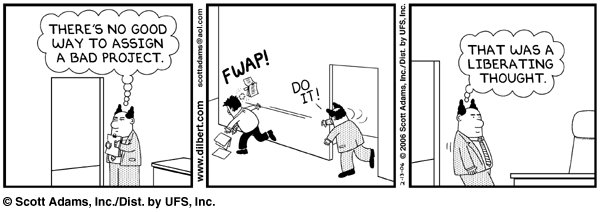
My personal view is that, when the project charter is issued, its your baby. You have no choice you should give the birth to the baby. But what you should do is., Understand all the issues clearly including all the politics,( remember there should be a very good reason to turn down an Assignment)Build you case. Make a very professional presentation by including the impact to the project due to the issues (very clearly). At last you should mention the predicted probability for the success based on your experience., and then present it to the board., Don't say that you don't like to do the project or to allocate it to somebody else., But say this is what you see in this project and get them to make the decision;. This is a safe and more professional approach, and more than anything… you have already informed your project board about your concerns even if you are to continue with the project.. But only the experienced PMs should try this.. Others .. Try your best and think of it as a good experience…

Thursday, March 09, 2006

PM - Is it necessary to have technical knowledge ???

2 comments
Yesterday, while talking to one of my customers , he mentioned that he has followed a Prince 2 course recently. while talking about the topic I realised that he was very strong with his opinion on that a PM doesn't need to have any technical knowledge., But my argument was that PM should be able to get on with techies, understand them, handle politics, manage conflicts and not allow the team to take the PM on a ride. In this case a PM should have a very good understanding of the technical aspects to make the project successful. Any way we paused the discussion as we met for an official meeting,
He is right when I think of PM theories, But in Practical I think when you are in to IT project Management, Guys …No matter whether you handle the biggest project in the world or the smallest ....Don't be lazy to update your technical knowledge….( Im not saying you should have knowledge to design a class diagram right or to code a component, But at least you should know what it is and should be able to understand the complexity of it.


Lately, I participated same type of discussion in a tech forum and the question was whether it's necessary for a PM to be technical ?. Though I wont agree 100% ,I find the following post is very interesting and it talks about most of the concerns we have in this issue. So I just thought to paste it here
-----------
There has been an on-going discussion for years as to how much technical background a project manager needs and I suspect it will continue through all of our life times.

First let me say that all project areas believe that they are different and unique. To a certain extent this is true. However, all projects have the same requirements for planning and control to some degree. In softer projects while the structure of good planning and control may not be as rigid as say a construction project, some form of structure is still needed. It becomes critical in large multi-disciplined technology projects, that the PM not only be able to lead the team but also to handle all of the internal political situations that will occur and to be able to sell and handle the corporate change that will occur. They simply cannot become too mired in the technical work.

Having said that my experience across a large number of technology projects in addition to other types tells me several things.

The smaller the project, the more technical background is needed. When a project of any technical type gets beyond a certain size of effort and team size, the more the PM needs to be more generally and business oriented. However, even in a very large project it would be best if the PM has some overview technical knowledge. They need enough to understand the project and to gain the respect of the team. But they do not have to be a highly skilled developer. Think about it, in a large, complex technology project, such as an ERP, we are usually dealing with a number of specialty areas within the technology and the PM cannot be conversant in-depth with them all and still have had time to become a highly skilled people manager.

I propose that what is needed on a larger project is a Technical Lead
working with and for the project manager/project director. the Technical Lead should have a technical architectural background and provide technical oversight of the product during its development. Is this not the same concept that engineering projects have. They will usually have a PM and a project engineer. Both are likely to be engineers of some variety.

The more experienced a PM is in managing projects, the longer they will have been away from any type of hands-on technical work and the less likely they will have in-depth knowledge of the latest tools and languages. This is the role of the Technical Lead. An expansion of the Technical Lead role is into what I call a Product Integrity Manager on the project responsible to the PM. In the expanded role, architecture is still key, but now we add all areas concerning the product, such as change control, documentation and quality.


Bill Bates
Principal
P3M Governance Inc.
bbates@p3mg.com
www.p3mg.com

What do you think? is it nessasary for a PM to be technical ? Developers.. Do you prefer to have a technical PM? feel free..my blog is open for your comments...

Tuesday, March 07, 2006

Learn to understand your team :)

1 comments
I really dont know how ... I think this is very true.. :)

Tuesday, February 28, 2006

Worldwide OLAP Market Share (Believe it or Not)

0 comments

Lately I have been working with BI solutions for enterprise and I find this article very interesting ;

http://www.olapreport.com/Market.htm

(Thanks to Bud for sending me this)

This has information of Market share Analysis of OLAP., I really didn’t believe that Microsoft has captured the OLAP market so aggressively.. Something really interesting..

Monday, February 27, 2006

Culture shock

0 comments

Managing Projects with Cross Cultures is one the challenging areas in Project Management. But I have always found it interesting and challenging.

Today I came up with these articles in Jerry’s Blog which made me write this

I think the success of a Project manager who manages projects with the stakeholders of other cultures will play a major role on how much they respect other cultures. Remember.. No matter how educated or qualified or professional we are , the nationality and the religion is a very sensitive topic when dealing with people from other cultures. My experience is based on working as a project Manager as well as a General Manager – Project Management Office for a company which deals with outsourced projects around the globe, from small 1 month 1 person projects to projects which goes over years with more than 20 IT professionals.

No matter which part of the globe we are located. As PMs we face same kind of issues every day, Time overruns, cost overruns, team delivery issues., technical issues.. of course we can talk about endless list of issues., Our interest are the same., May be our qualifications are the same.. Then what is different ….??? The difference comes with our cultures, the way we do things, though the problem is the same.. our approaches will be different., the way we deal with the problem will be different.. And this is what it makes interesting.

When you get a customer /Project Owner /or a team from another country, as the Project Manager, you are the key person to understand each other’s culture and the way they do things very carefully. Once I had a customer from Europe, Who used the “F” word when ever his project was in trouble and he was in presure .. Coming from an Asian country, in the beginning this was very hard for me to deal with. I felt its really harsh.. But I tried to ignore those extra words and read the other part (Which was quite sufficient to understand what he said). Then I found that other than those words , what ever he said, everything looked fine and true and reasonable. so I got used to it .. But in the same time I mentioned to him that in my country,. we do not use this language in Business.. He sincerely accepted it.. so it created an environment for us to work with a better understanding and better respect to each other..

Recently I was managing a project for one of the biggest multinational companies in Pakistan. When I went there.. I found that things will not be the same (Specially me being a woman, I was advised from various people that it will be very hard for me to deal with Pakistanis).. But after few days.. Everything turned totally opposite.. Not only they were corporative with me, I was touched by their hospitality. Some of their client companies who didn’t even have 1 woman working for them were totally corporative and supportive to me and my team. Rule No 01.I respected their culture., I totally changed the way I normally dress to office. I even learnt to speak few words of their language.. With few extra things.. All my hard work was paid off. Both our teams worked together as 1 team for 1 goal. It became one of the most successful projects in my life.

Coming from this part of the world., the way we deal with our teams may be different from the way a PM from a western country will deal with. Some times we need a very indirect approach to sort out certain things. Specially handling with female team members... ( ok I will not talk much on that As Im a female too : -)

At last..this is something which I have observed.... I think PMs from India and SL have low rate of project failures compared to the PMs in western countries.. Anybody wonder why??? When I talked to some of the Project managers living in other part of the world… I found that they are very methodical (Pardon me Im not saying we are not methodical). They work with defined tasks, Budgets.. resources….. If any of these parameters are not in balance.. They close the project as a project failure.. But we…. Coming form a Outsourced Project environment.. …………. Even if the developer is absent,, Project Manager by himself will write the code and deliver.. Because one simple reason that we cannot afford a project failure… Im not saying this is a good practice though.. This is something which I will discuss in another post in the future….

I just started a separate section in my blog to share the blogs of other project managers around the world. Hope this will be interesting…

A smart project manager will always get the maximum benefit of the culture difference when dealing with the Stakeholders from other cultures.


Very useful resource:

http://www.pmi-netherlands-chapter.org/pdfdocs/Culture24novNL.pdf

Friday, February 24, 2006

Extraordinary Projects

2 comments
I just thought of setting some extra goals for my teams to achieve this year. (suddenly I thought of this while driving to the office today...).I have some targets (except to my usual work) for this year.. To get CMM (at least Level 3) Certification for the Company, Win National Best Quality Software Awards – 2006 and to convert the existing Microsoft Partnership to a Gold Partner.
With these objectives, I split one part of the team in to 3 teams. Then we assigned each goal as a project to each team. They have to select a leader among them to drive the project. This is actually a challenge to every team as they have to achieve the tasks out of their usual work. In this way there is a chance for everybody to prove their capabilities, improve on presentation skills.. Feel the pressure of driving a project(hmm.. I like that part the most... .. ) , a great achievement and more than everything.. it will be lots of knowledge and fun for everybody. We agreed to meet once a month to discuss about the progress of the project.

I think this is a good approach for a SME like our company who doesn’t have million $ budget to allocate on awareness programs and to improve standards.
End of the year, we will be selecting the best team, based on achievements, approach, leadership skills, coordination and teamwork. And this will be a part of their yearly review.. Im just excited to see the results…

Wednesday, February 22, 2006

Velocity 2006

2 comments

I know I’m deviating from my normal topic Project Management. But I thought its worth to spend few minutes to write about Microsoft 2006 Partner conference in SL (Velocity)

Yesterday the whole day I was at Velocity. Thanks to the people who selected the venue.. Waters Edge is one my favorite places in Colombo.(any nature lover will admire this place.. anybody visiting Colombo , this is closer to the Parliament, by the side of beautiful “Diyawanna Oya” )

However I’m not bios towards one technology. Either Microsoft or Linux or what ever the technology, my interest is to manage the project and deliver its best value to the Stakeholders. But the place was full with “Microsoft Fans” (How can I be like that while using firefox Browser and thunderbird mail client. ? :( )

By starting the event, the Country Manager gave a speech based on IT sector of Sri Lanka.. He didn’t forget to mention the most popular problem what we always discuss in any IT event “IT resources in Sri Lanka” As he said it’s a very big problem. In SL, we find difficult to recruit good IT resources. Only few skilled people are rotating in companies, In his own words, Its like a “Merry-go-Round” When we know a good developer in another company we offer few bucks more and recruit him, after few months another company will do the same to us.. By continuing like this we will not go anywhere. Hmmm.. Something to think about seriously… He requested from partners to invest on IT skill development of the employees.. But then again.. How many companies will recover that investment in a floating resource market like this? Do you invest money and time to train a person for another to recruit.. The problem is even more complicated.. Any way I can talk about this for 1 whole day with my past experience by interviewing Developers for project requirements J It’s a nightmare..

Another point which he highlighted was the Licensing issue. We complain that the customers do not understand the value of Software.. But.. Do we understand it?? How many of us are using licensed copies of Software.. ? My personal belief of Microsoft Software Licensing is something different.. But I better not discuss it here .. ^^&^$#& )

The presenter who presented Miscrosoft Vs Linux was capitalizing on him working for Redhat before joining Microsoft. I really wonder How many of XMicrosoft guys must be working for Redhat at the moment. (What a business World ........)

Windows Vista was presented to the audience with a small demo. The presenter tried to do a small example to make it more interesting. Unfortunately the Example didn’t work ………………………….(Any way Im not a baby tux to say .. Another Microsoft Product… So I would say.. these things happens in presentations…) But overall, Vista looks like a really cool product to play with..

The Last lecture was given by an Indian Dr. and that was the best lecture of the whole event. His lecture was focused on how a technical person would map IT with business requirements for a successful sale.

Following is one of the examples given by him;

He said that windows 2003 Server has over 3500 Features

He questioned the product resellers and IT guys in the audience; what are the features used by their customers… and then he listed them, and counted them there were 8 features.

So the customer buys Windows 2003 Server for Rs. 80,000 (Example)

Windows 2003 Server has over 3500 Features

So the value of 1 feature = Rs.22.85

The value he gets by spending Rs.80,000 is Rs. 182.8

So who’s problem is this ? Microsoft’s? Customers? Or the person who sells it?

May be it’s a silly example. But this tells a long story about our selling

Not only for selling Microsoft products. We can relate this to any product selling we do.

“Forest Trust” was another good example of him to explain why Technical guys fail in convincing higher management of an organization.

Any way its really a rear skill to find IT guys who are good in their technical knowledge as well as selling. People who have that ability are always a success.

At last as usual the cocktail …….. :) People and time to gossip about industry news.. Hey where is this person working now.. Oh the looser is in that place..? How is business.. So How is the IT market…… Yeahhh. Its better to move out of IT now…….But I didn’t spend much time there as I was getting late……………

Sunday, February 19, 2006

Six Sigma Black belt

0 comments

I have been searching how to get Six Sigma Black belt from Sri Lanka (Its not something to do with Martial Arts any way.. It’s a Project Management Qualification) and I found this Article today.

In this http://www.asq.org/certification/docs/ssbb_brochure_04_2.pdf I find quite useful information about the certification process .

Thursday, November 17, 2005

Power of a PM

0 comments

To Manage a project, project Manager should have power., The PM’a Power can be categorized as follows;

· Formal authority resulting from an official capacity which is empowered to issue orders.

· Reward and/or penalty power resulting from his/her capacity to dispense directly or indirectly valued organization rewards or penalties.

· Expert power when the project manager is perceived as possessing special knowledge or expertise for the job.

· Attractive power because the project manager has a personality or other characteristics to convince others.

· Referential power when Project Manager has support from a specific senior Manager., to use his powers to get work done from the others.

However its not recommended to use Referential Power (Ex: Because the CEO personally requested me to get this task done by today, you have to do it)and Penalty Power(Ex: if you do not complete this task before end of today, you cannot get your week end off) in Managing projects. Its always better to use the Expert Power., By using expert power you can convince others reasonably and easily, Attractive power is a must for a PM., as Pming includes lots of negotiations with all the stakeholders of the project.

Thursday, November 03, 2005

PMP

9 comments


Its Awesome! I had to wait 6 weeks to get results as I did the Offline PMP Exam, waiting for results was just killing me.. But there is no more waiting.. Im a PMP at last !!!

My best advise for any candidate who wants to take up PMP Exam is to

Apply the PMBOK theories with your Practical Experience ., If you don’t do EVM and NPV calculations for your projects , start doing it., That’s the best way to study for PMP. I did that and I see the results now in 2 ways .

  1. I became a PMP
  2. I got myself adopted to the PMI methods of managing projects..

Wednesday, August 17, 2005

How Delphi Technique Works?

1 comments

The process can be completed in a few short meetings by a panel of experts, by the corporate associates at large in a series of questionnaires, or by a hybrid of the two. The description below is vague when company policy or facilitator discretion may be used to invoke a variation.

  1. Pick a facilitation leader.

  2. Select a person that can facilitate, is an expert in research data collection, and is not a stakeholder. An outsider is often the common choice.

  3. Select a panel of experts.

  4. The panelists should have an intimate knowledge of the projects, or be familiar with experiential criteria that would allow them to prioritize the projects effectively. In this case, the department managers or project leaders, even though stakeholders, are appropriate.

  5. Identify a strawman criteria list from the panel.

  6. In a brainstorming session, build a list of criteria that all think appropriate to the projects at hand. Input from non-panelists are welcome. At this point, there is no "correct" criteria. However, technical merit and cost are two primary criteria; secondary criteria may be project-specific.

  7. The panel ranks the criteria.

  8. For each criterion, the panel ranks it as 1 (very important), 2 (somewhat important), or 3 (not important). Each panelist ranks the list individually, and anonymously if the environment is charged politically or emotionally.

  9. Calculate the mean and deviation.

  10. For each item in the list, find the mean value and remove all items with a mean greater than or equal to 2.0. Place the criteria in rank order and show the (anonymous) results to the panel. Discuss reasons for items with high standard deviations. The panel may insert removed items back into the list after discussion.

  11. Rerank the criteria.

  12. Repeat the ranking process among the panelists until the results stabilize. The ranking results do not have to have complete agreement, but a consensus such that the all can live with the outcome. Two passes are often enough, but four are frequently performed for maximum benefit. In one variation, general input is allowed after the second ranking in hopes that more information from outsiders will introduce new ideas or new criteria, or improve the list.

  13. Identify project constraints and preferences.

  14. Projects as a whole are often constrained by total corporate budget, or mandatory requirements like regulatory impositions. These "hard constraints" are used to set boundaries on the project ranking. More flexible, "soft constraints" are introduced as preferences. Typically, hard constraints apply to all projects; preferences usually apply to only some projects. Each panelist is given a supply of preference points, about 70% of the total number of projects. (For example, give each panelist 21 preference points if 30 projects have been defined.)

  15. Rank projects by constraint and preference.
    1. Each panelist ranks the projects first by the hard constraints. Which project is most important to that panelist? Some projects may be ignored. For example, if the total corporate budget is 100 million, the panelist allocates each project a budget, up to the maximum requested for that particular project, and such that the total of all budgets does not exceed the $100 million. Some projects may not be allocated any funding.
    2. Next each panelist spreads their preference points among the project list as desired. Some projects may get 10 points, others may get none, but the total may not exceed the predefined maximum (21 in our example above).

  16. Analyze the results and feedback to panel.

  17. Find the median ranking for each project and distribute the projects into quartiles of 25, 50, and 75-percentiles (50-percentile being the median). Produce a table of ranked projects, with preference points, and show to the panel. Projects between the 25th and 75th quartile may be considered to have consensus (depending on the degree of agreement desired); projects in the outer-quartiles should be discussed. Once the reason for the large difference in ranking is announced, repeat the ranking process.

  18. Rerank the projects until it stabilizes.

  19. After discussing why some people (minority opinion) ranked their projects as they did, repeat the rankings. Eventually the results will stabilize: projects will come to a consensus, or some will remain in the outlier range. Not everyone may be persuaded to rank the same way, but discussion is unnecessary when the opinions stay fixed. Present the ranking table to the decision makers, with the various preferences as options, for their final decision.


Be a PMP
 

PROJECTIZED. Copyright 2008 All Rights Reserved Revolution Two Church theme by Brian Gardner Converted into Blogger Template by Bloganol dot com